Gratuity calculation in the UAE: has anything changed? The formula, the savings scheme and one raise worked both ways
UAE gratuity calculation has not changed since 2 February 2022: 21 days of basic salary a year for five years, 30 days after, capped at two years' wage. What changed is the optional savings scheme at 5.83% and 8.33% of basic a month, worked on one AED 8,000 salary.
Twenty-one days, thirty days, a two-year cap: UAE gratuity calculation has not changed, and those three numbers are still the whole formula. Article 51 of Federal Decree-Law 33 of 2021 reads today exactly as it did when the law took effect on 2 February 2022, and the u.ae page that summarises it, last updated on 15 October 2026, still shows the same four lines. What has changed is the thing around the formula. Since late 2023 an employer can opt out of the lump sum altogether and pay the gratuity monthly into an investment fund instead, and that produces a different number at the end.
At the trading company where I work, the two get mixed together every time a news item mentions "end of service". This post separates them and works one invented salary under each.
What does the current UAE gratuity formula actually say?
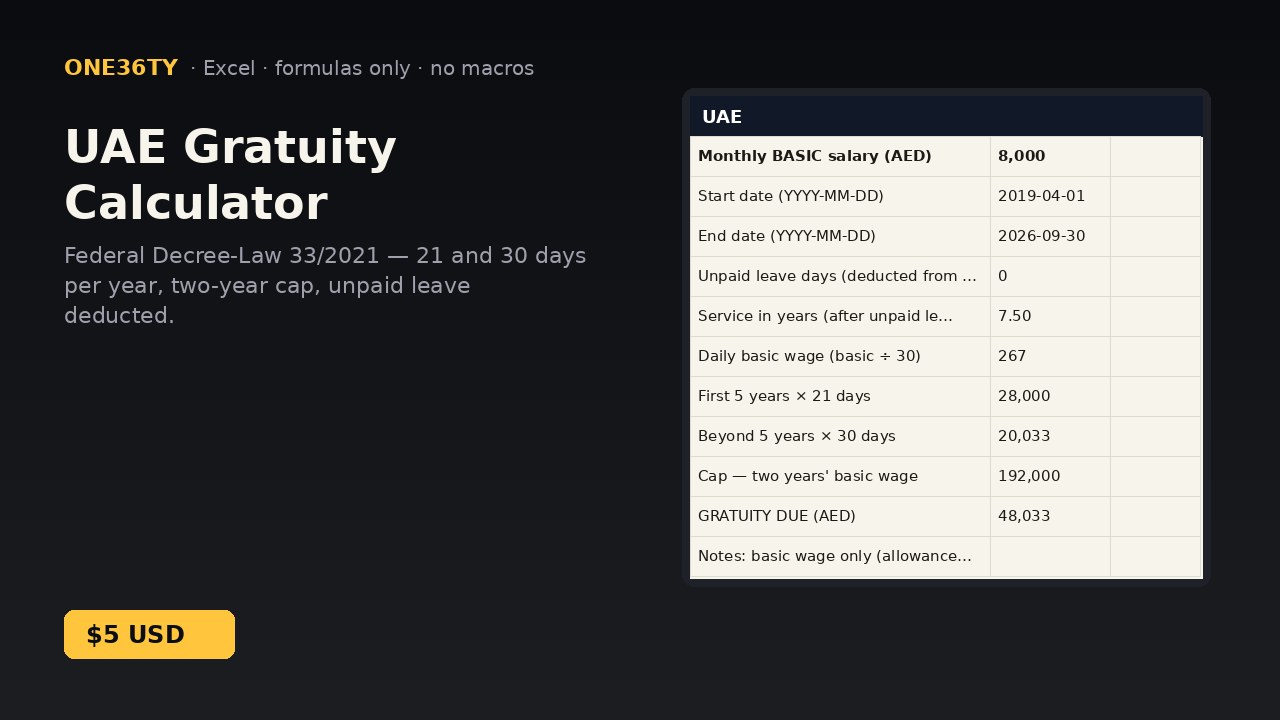
The u.ae summary of Article 51 is four lines, each worked on one salary in the 21-day and 30-day post. Under one year of service, the worker is "not entitled to any gratuity pay". From one to five years, "full gratuity pay based on 21 days' salary for each year of work". Past five years, "30 days' salary for each year of work following the first 5 years". And in all cases "total gratuity shall not exceed the wage of 2 years". The page adds that the figure is calculated on the "basic salary", which leaves out housing and transport allowances (the reason is in basic salary against the total package), and that "days of unpaid absence are not included in service calculations".
None of that is new. The decree-law's own Article 51 uses the same words, "a wage of (21) twenty-one days for each year of the first five years of service" and "a wage of (30) thirty days for each year exceeding such period", and the resignation cuts that the 1980 law carried are gone, as I covered in resignation against termination. MOHRE's consolidated text marks the articles that Federal Decree-Law 9 of 2024 amended, and Article 51 carries no such mark. The days per year, the cap and the wage definition have not moved since 2022.
What is the end-of-service savings scheme, and does it change the amount?
The change is Cabinet Resolution No. 96 of 2023, and Article 51 itself left room for it: clause 8 lets the Cabinet "approve other alternative schemes for the end of service benefits scheme". EY's alert of 19 December 2023 describes the scheme as issued on 10 October 2023 and sets out the rates: "For members with less than five years of service: 5.83% of the basic monthly salary" and "For members with five years of service or more: 8.33% of the basic monthly salary". The employer pays those amounts every month into an approved fund. At the end of service the u.ae page says the worker receives "all basic subscription amounts paid by the employer and any returns resulting from it", within 14 days.
Two things about those percentages. First, they are the old formula rewritten as a monthly rate. Twenty-one days out of a 30-day month is 0.7 of a month per year; divided by twelve months that is 5.83% a month. Thirty days is a full month per year, or 8.33% a month. The scheme did not invent new generosity; it took the same two tiers and spread them across the payslip.
Second, the base is different in time. The lump-sum formula applies the final basic wage to every year worked. The scheme applies the basic wage of each month as it goes, and then adds whatever the fund returns. Past service is not rewritten either: Bracewell's note of 13 January 2026 on the MoHRE guidance issued in November 2025 says "employers remain obligated to preserve and pay out pre-enrolment gratuity accrued under the UAE Labour Law".
The percentages are the 21-day and 30-day tiers turned into a monthly deposit. What moves is which salary they are applied to, and what the money does in between.
The scheme is voluntary for the employer, not the employee. EY also records that a worker can add their own money, but "the voluntary subscription percentage cannot exceed 25% of the total salary". The January 2026 guidance names four approved providers and says employees "can choose from a range of investment options, including capital-guarantee, risk-based and Sharia-compliant funds". Gulf News adds that "non-skilled workers are automatically placed in capital-guaranteed portfolios".
How does one raise come out under the formula and under the scheme?
Take an invented basic salary of AED 8,000 for the first three years, raised to AED 10,000 from the start of year four, with six full years of service and no unpaid leave. For the scheme I assume the employer enrolled the worker on day one and I use the published rates as printed, 5.83% and 8.33%.
Lump sum under Article 51. The final basic is AED 10,000, so a day is 10,000 ÷ 30 = AED 333.33. Years one to five pay 21 days each: 5 × 21 × 333.33 = AED 35,000. Year six pays 30 days: AED 10,000. Total AED 45,000. The raise in year four is applied backwards to years one to three, because clause 5 of Article 51 calculates the benefit "according to the last basic wage the worker was entitled to". The same arithmetic on an Indian employee's salary is in the India gratuity calculator post.
Monthly under the scheme, before any return. Years one to three: 5.83% × 8,000 = AED 466.40 a month, times 36 months = AED 16,790. Years four and five: 5.83% × 10,000 = AED 583 a month, times 24 = AED 13,992. Year six: 8.33% × 10,000 = AED 833 a month, times 12 = AED 9,996. Total deposited: AED 40,778.
| Formula (last basic) | Scheme (basic each month) | |
|---|---|---|
| Years 1 to 3 | 21,000 | 16,790 |
| Years 4 to 5 | 14,000 | 13,992 |
| Year 6 | 10,000 | 9,996 |
| Total | 45,000 | 40,778 plus fund returns |
The AED 4,222 gap is almost entirely the raise reaching back over the first three years. In the formula that reach-back is automatic. In the scheme, the fund's return over six years has to do the same work, and no labour law or spreadsheet can promise that it will. Someone whose basic never changes has a far smaller gap, and the capital-guarantee option exists for people who would rather not run the comparison at all.
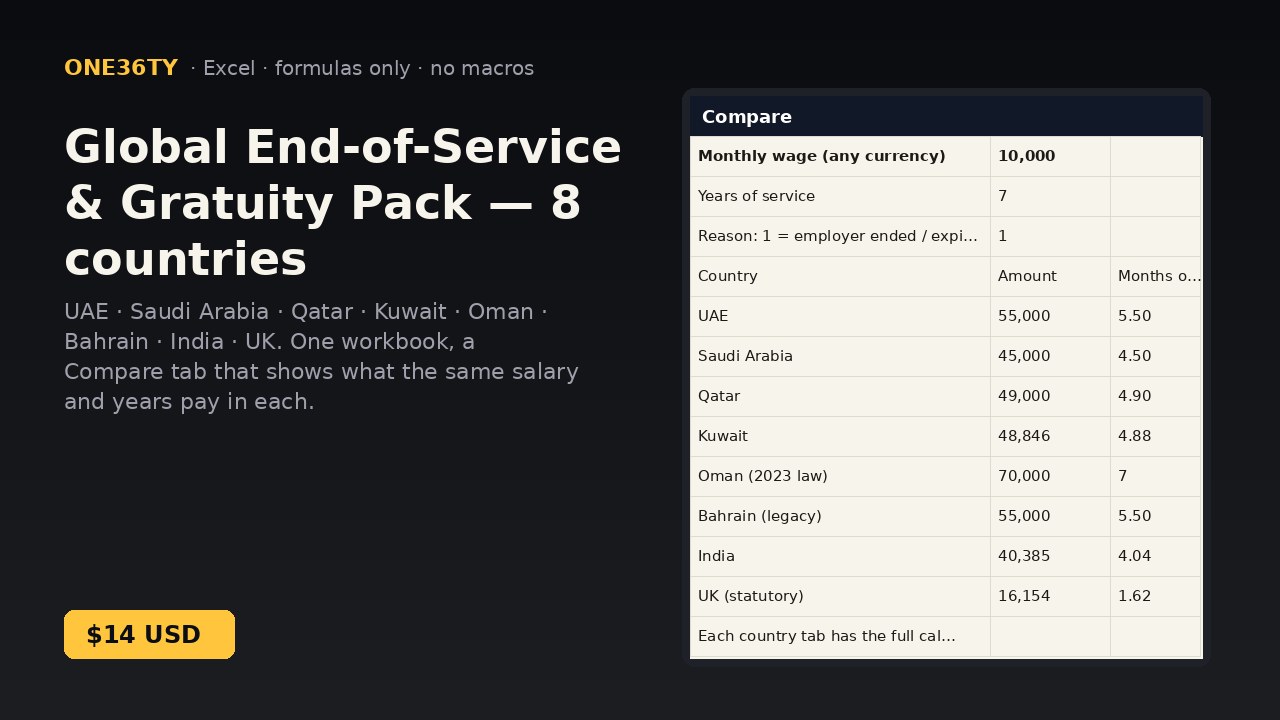
This is arithmetic, not a view on which arrangement is better, and the employer makes the choice anyway. The studio's UAE gratuity sheet does the Article 51 side; the scheme side lives on a fund statement.
The thing I keep noticing is that the search phrase is right and wrong at the same time. The calculation did not change. The place where the money sits while it is being earned did, and that turns out to matter more than any tweak to the days per year would have.
Sources
- End of service benefits for workers in the private sector · u.ae, The Official Platform of the UAE Government (updated 15 Oct 2026)
- Federal Decree-Law No. (33) of 2021 Regarding the Regulation of Employment Relationships and its amendments (Article 51) · Ministry of Human Resources and Emiratisation (MOHRE)
- UAE introduces voluntary alternative end-of-service benefits scheme · EY Global Tax Alert, 19 Dec 2023
- New MoHRE Guidance on the UAE's Alternative End-of-Service Benefits Scheme · Bracewell LLP, 13 Jan 2026
- Invest your gratuity: UAE's new end-of-service savings scheme explained for employees · Gulf News, 5 Apr 2025