UAE gratuity on resignation vs termination: what changed in 2022 and what did not
Under the old UAE labour law, resigning before five years cut the gratuity to a third or two-thirds. Federal Decree-Law 33/2021 dropped that rule. One AED 9,000 basic salary worked under both laws, plus what the notice period and unpaid leave still do to the number.
AED 9,000 basic salary, four years of service on an unlimited contract, and a resignation letter. Under the law that applied in the UAE until early 2022, that letter cost AED 8,400: the gratuity was AED 16,800 for the person who resigned and AED 25,200 for a colleague on the same salary whose contract the employer ended. Today both get AED 25,200.
At the trading company where I work, people who have been in the country a long time still ask the old question first: "If I resign, do I lose part of it?" The answer changed on 2 February 2022, and office talk has not caught up. The salary is invented for the example; the articles are quoted from the published texts.
Did resigning used to reduce UAE gratuity?
Yes. The old law was Federal Law No. 8 of 1980, and I am quoting its articles from a Khaleej Times legal column of 7 October 2017 that reproduces them.
Article 132 set the base figure, and it looks familiar: "21 days' remuneration for each year of the first five years of service" and "30 days' remuneration for each additional year of service provided that the aggregate amount of severance pay shall not exceed two year's remuneration."
Article 137 then cut it for anyone on an unlimited contract who left by choice: "Where an employee, who is bound by a contract of unlimited duration leaves his work of his own accord after continuous service of not less than one year and not more than three years, he shall be entitled to one-third of the severance pay provided for in the preceding article; where the continuous period of service exceeds three years but does not exceed five years, he shall be entitled to two-third of such severance pay". The full amount came only once service exceeded five years.
Limited contracts were treated more severely. Under Article 138, an employee who "leaves his work of his own accord before the expiry of his contract period" was not "entitled to severance pay unless his continuous period of service exceeds five years."
Article 139 removed the whole amount when the employee was "dismissed from service for any of the reasons specified in Article 120 of this Law" or, with some exceptions, left "of his own accord and without notice".
What does Federal Decree-Law 33 of 2021 say about resignation and gratuity?
Nothing, and that is the change. Article 73 of the new law reads: "Federal Law No. (8) of 1980 regulating employment relationships shall be abrogated." Article 74 says it "shall be enforced as of 2 February 2022."
Article 51, clause 2, gives the benefit to "The full-time foreign worker, who completed a year or more in continuous service", who "shall be entitled to end of service benefits at the end of his service". The words do not say who ended it. The clause keeps the same two tiers: "A wage of (21) twenty-one days for each year of the first five years of service" and "A wage of (30) thirty days for each year exceeding such period". No article after it plays the part of the old 137, 138 or 139. The u.ae summary of the calculation has four lines, three by length of service and one for the two-year cap. None mentions the reason for leaving.
Article 44 still lists ten cases in which an employer "may dismiss the worker without notice", from forged documents to more than seven consecutive days of unexcused absence. What the worker loses in that text is the notice; end of service benefits are not mentioned.
The old law asked who ended the contract and then cut the gratuity. The current one asks only how long the service was.
How does one salary come out under the old rules and the new?
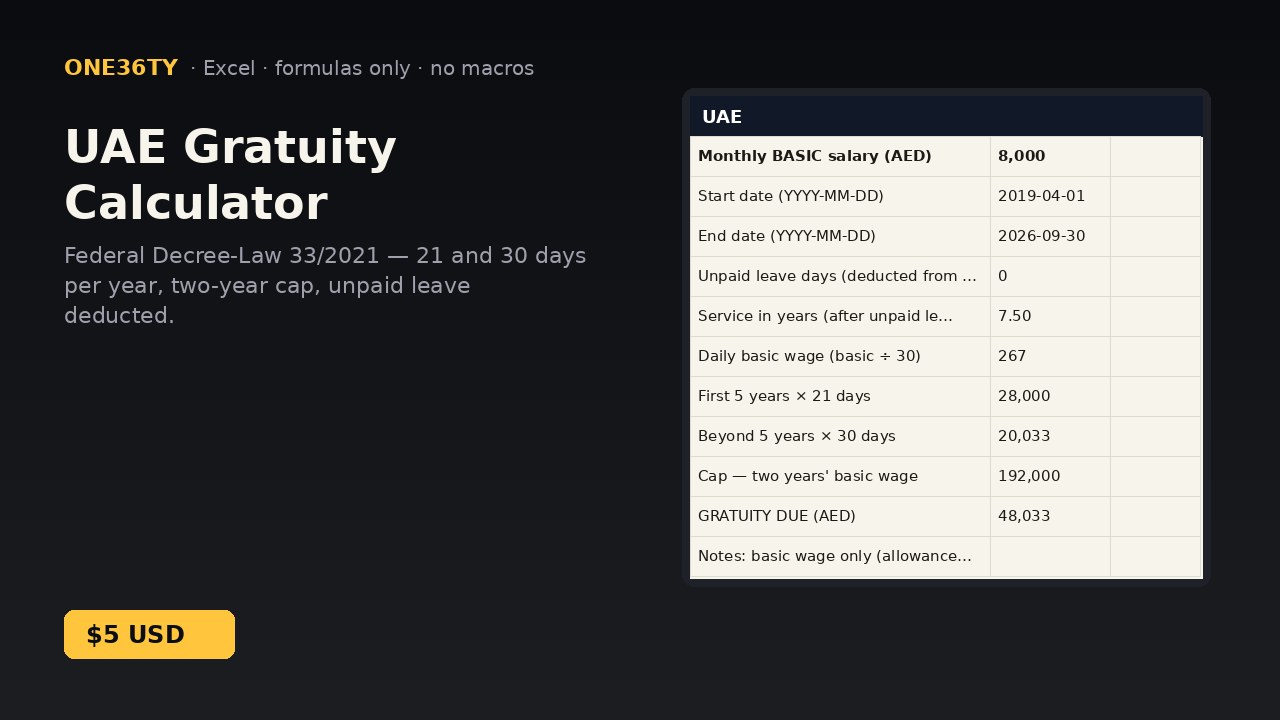
Basic salary AED 9,000. Article 67 of the new law says "the month represents (30) thirty days", which is the basis calculators use for the daily figure: 9,000 ÷ 30 = AED 300. A year within the first five is 21 × 300 = AED 6,300, and a year after that is 30 × 300 = AED 9,000. The same 9,000 is used under both laws.
| Service | Full gratuity | Old law: resigned, unlimited contract | Old law: resigned early, limited contract | Current law: resigned or terminated |
|---|---|---|---|---|
| 2 years | 12,600 | 4,200 (one-third) | 0 | 12,600 |
| 4 years | 25,200 | 16,800 (two-thirds) | 0 | 25,200 |
| 6 years | 40,500 | 40,500 | 40,500 | 40,500 |
The six-year row is 5 × 6,300 = 31,500, plus one year at 9,000. Past five years the old law already paid a resigning employee in full, which is how the five-year mark became office folklore. Under the current text all the mark does is switch the rate for later years from 21 days to 30.
What do the notice period and unpaid leave do to the figure?
Notice. Article 43 lets either party end the contract with written notice of "not less than (30) thirty days and not more than (90) ninety days". Clause 2 says the contract "continues to be valid throughout the notice period referred to in this Article and is terminated upon expiry of such period". So the service being counted ends on the last day of notice, not on the date of the letter. Under clause 3 the party who skips it "shall pay to the other party compensation, which is called notice period allowance", equal to the wage for the notice left unserved. It runs in whichever direction the breach did.
Unpaid leave. Article 51, clause 4: "The unpaid days of absence from work shall not be included in the calculation of the service term." On the four-year row, 60 days of unpaid leave is two 30-day months, so the service counted is 46 months. At 6,300 ÷ 12 = AED 525 a month, that is AED 24,150, or AED 1,050 less than the full four years.
One leftover. Article 68 covers contracts signed under the 1980 law, and clause 3 says "the employer may calculate the end of service benefits in accordance with the provisions of the employment contract with an undefined term stated in Federal Law No. (8) of 1980". I read that as a transition clause for converting the old unlimited contracts. How it applies to any single contract is a question for MOHRE, not for a blog.
None of this is advice on whether or when to resign. It is the arithmetic only, the same the studio's UAE gratuity sheet does from a start date, an end date and the unpaid days.
What strikes me is how long a repealed rule can keep working on people. I still hear colleagues say they are "waiting for five years" before handing in a letter, long after the clause that made five years matter for a resignation was abrogated. The formula on the page is simpler than the one in people's heads.
Sources
- Federal Decree-Law No. (33) of 2021 Regarding the Regulation of Employment Relationships and its amendments · Ministry of Human Resources and Emiratisation (MOHRE)
- End of service benefits for workers in the private sector · u.ae, The Official Platform of the UAE Government (updated 12 Aug 2026)
- Planning to quit job in UAE? Here's what your employer should pay you (quotes Articles 132, 137, 138 and 139 of Federal Law No. 8 of 1980) · Khaleej Times, legal column by Ashish Mehta, 7 Oct 2017