How to calculate end of service: the calculator steps, worked on one UAE salary from 1 to 20 years
An end of service calculator takes four inputs and runs five steps. Worked on an AED 12,000 basic salary in the UAE from one year to twenty, with the fraction-of-a-year and unpaid-leave steps most people skip, and the Saudi, Qatar, Kuwait and Bahrain formulas set beside it.
Watch this as a video
UAE Gratuity Calculator in Excel — 21 and 30 days per year, two-year cap · Masrofna · opens on YouTube
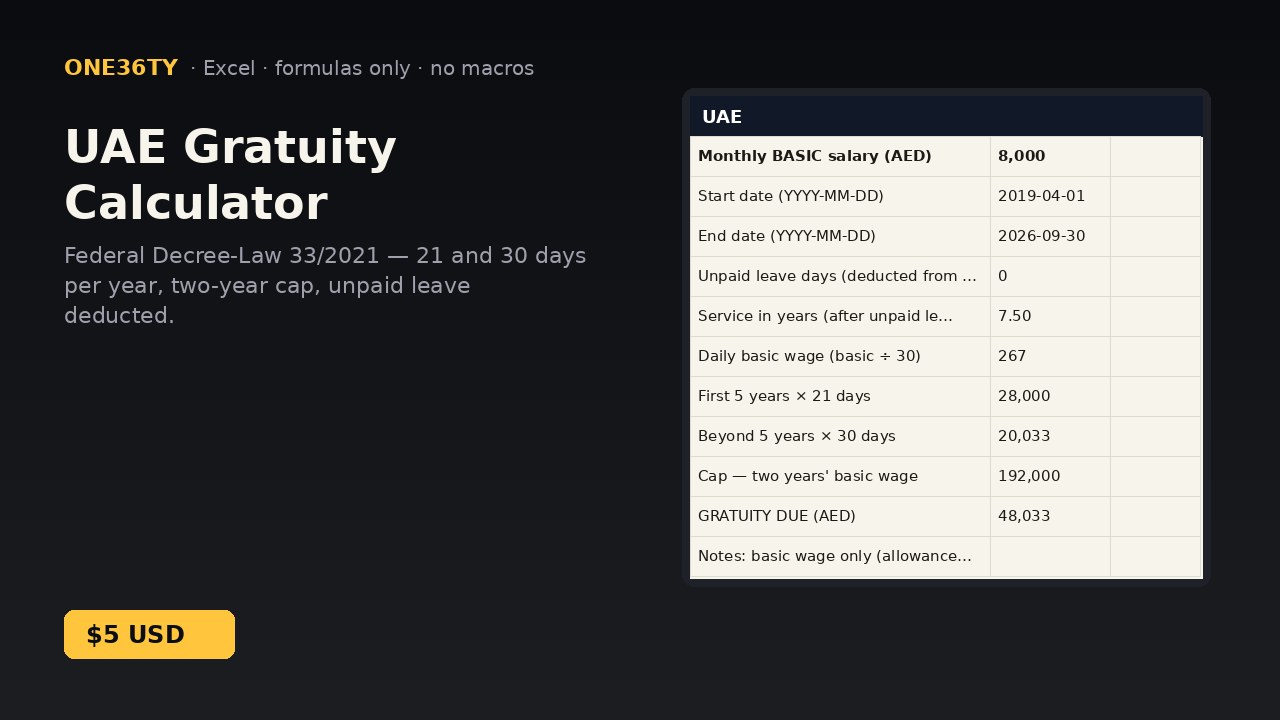
AED 73,729. That is the UAE end of service gratuity on a last basic salary of AED 12,000 for someone who joined on 1 March 2019 and leaves on 21 October 2026. To calculate end of service the way a calculator does, it needs four inputs: last basic salary, start date, end date, and any days of unpaid leave. It then runs five steps in a fixed order: daily rate, length of service, the 21-day tier, the 30-day tier, the cap. The steps below are the whole machine.
The rules are Article 51 of Federal Decree-Law 33 of 2021, the UAE Labour Law. Every UAE sentence in quotation marks below is copied from one page, "End of service benefits for workers in the private sector" on u.ae, the UAE government portal (updated 15 October 2026, read on 21 October 2026), the first entry in the references.
What does an end of service calculator actually ask for, and why?
Input 1, last basic salary. The page says the gratuity "is calculated on basis of last wage which the worker was entitled to, namely the basic salary. Hence, it will not include allowances such as housing, transportation, utilities, furniture etc." Step one turns the monthly basic into a daily one. The page does not fix a divisor; the usual convention is a 30-day month, so AED 12,000 ÷ 30 = AED 400 a day.
Inputs 2 and 3, the dates. Step two is the length of service. From 1 March 2019 to 21 October 2026 inclusive is 2,792 days. Divided by 365.25 that is 7.644 years. The fraction matters: "Workers are entitled to gratuity for fractions of a year, proportionate to the time served, provided they have completed one year of continuous service." Below one year the whole thing is zero: "If a worker has served for less than 1 year, he is not entitled to any gratuity pay."
Input 4, unpaid leave. "Days of unpaid absence are not included in service calculations." The calculator subtracts them from the day count before it divides, not from the money afterwards.
Then the three arithmetic steps, on 7.644 years and AED 400 a day:
- First five years at 21 days each: 5 × 21 × 400 = AED 42,000.
- Years after the fifth at 30 days each: 2.644 × 30 × 400 = AED 31,729.
- Add them: AED 73,729. Check against the cap, "the total gratuity shall not exceed the wage of 2 years", which is 24 × 12,000 = AED 288,000. Nothing happens.
Add twelve days of unpaid leave and service drops to 2,780 days, 7.611 years, and the gratuity to AED 73,335. A calculator that counts whole months instead of days gives AED 73,658. The law says "proportionate to the time served" and no more, so two honest calculators can differ by a few hundred dirhams.
The order is the formula. Daily rate, then days of service, then the tiers, then the cap. Swap any two and the number is wrong.
How does the number grow from year 1 to year 20 on the same salary?
In months of basic salary, 21 days is 0.7 of a month and 30 days is one month. So the first five years earn 3.5 months in total and every year after adds one. On AED 12,000:
| years served | months of basic | gratuity (AED) |
|---|---|---|
| 1 | 0.7 | 8,400 |
| 5 | 3.5 | 42,000 |
| 6 | 4.5 | 54,000 |
| 10 | 8.5 | 102,000 |
| 20 | 18.5 | 222,000 |
The line to notice is between year five and year six. Up to year five each year adds AED 8,400; from year six each adds AED 12,000. The 30-day rate "for each year of work following the first 5 years" applies only to those later years; the first five stay at 21 days. The two-year cap, 24 months, is not reached anywhere in this table. It needs 20.5 months after year five, about 25 and a half years of service, so for almost everyone the cap is a sentence in the law rather than a step in the calculation.
How is end of service calculated in Saudi Arabia, Qatar, Kuwait and Bahrain?
The same four inputs feed a different machine in each country. Colleagues at the trading company where I work who came from Riyadh or Doha still carry the old formula in their heads. The last column uses a 30-day month for Qatar and Kuwait.
| country | base | tiers | cap | after 10 years, in months of the base |
|---|---|---|---|---|
| UAE | last basic salary | 21 days per year for 5 years, then 30 days | 2 years' wage | 8.5 |
| Saudi Arabia | last wage | half a month per year for 5 years, then one month | none stated | 7.5 |
| Qatar | final basic salary | not less than three weeks per completed year | none stated | 7.0 |
| Kuwait | remuneration | 15 days per year for 5 years, then one month | 1.5 years' remuneration | 7.5 |
| Bahrain, service before March 2024 | wage | half a month per year for 3 years, then one month | none stated | 8.5 |
Two rows carry a resignation step the UAE dropped in 2022. Saudi Arabia's Article 85 cuts the award for someone who resigns: "one third of the reward" between two and five years, "two thirds of the reward" from five to under ten, the full award from ten. Kuwait does the same at different points: "half of their end-of-service indemnities if they resign having completed between three and five years of service", two-thirds from five to ten, the full amount at ten. Qatar sets a floor, not a formula: the benefit "can be agreed between the parties provided it is not less than three weeks of the employee's final basic salary for each completed year of service".
Bahrain changed the machine. Under Resolution No. 109 of 2023, which "came into effect in March 2024", the employer pays the Social Insurance Organisation "4.2% of the employee's annual salary for each of the first three years of employment, and 8.4% of the employee's annual salary for subsequent years until termination", and the SIO pays the worker at the end, capped at the contributions paid in. Entitlements "accrued prior to March 2024" are "still required to be paid directly from the employer to employee" under the Article 116 tiers. A Bahrain calculator needs a fifth input, the date 1 March 2024, and runs a formula on each side.
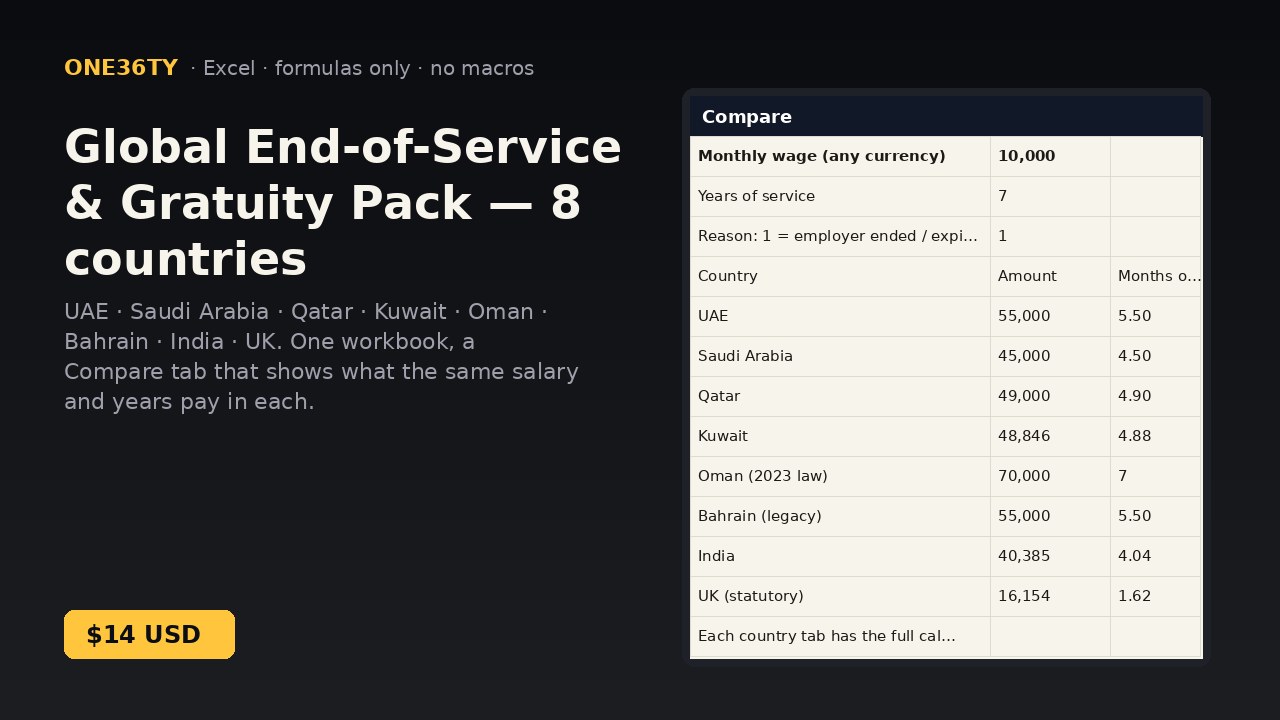
Nationality never enters any of these. An Indian employee on a UAE contract is paid on the UAE row, not on India's formula, which the India gratuity post works through. The studio's Gulf pack has one tab per row and a Compare tab that runs the same salary and dates down all of them.
Building those tabs taught me that the arithmetic in each country takes about four cells. The work is in the inputs: which salary line, which dates, which days to strip out, and which side of a legal date the service falls on. Get those right and any calculator, or a sheet of paper, gives the same answer.
Sources
- End of service benefits for workers in the private sector · u.ae, The Official Platform of the UAE Government (updated 15 Oct 2026, checked 21 Oct 2026)
- Federal Decree-Law No. (33) of 2021 Regarding the Regulation of Employment Relationships and its amendments (Article 51) · Ministry of Human Resources and Emiratisation (MOHRE)
- End-of-service award regulations (Articles 84 and 85) · Ministry of Human Resources and Social Development, Saudi Arabia
- Termination of Employment and End of Service Benefit in Qatar - A Summary (Article 54 of Law No. 14 of 2004) · Clyde & Co, 23 February 2016
- Labour Law in Kuwait (Law No. 6 of 2010, end-of-service indemnity) · Al Tamimi & Company via Mondaq, 8 December 2010
- Amendments to the Mechanism for End of Service Entitlements (Bahrain, Resolution No. 109 of 2023) · Paul Hastings, 2 February 2026
- Bahrain end-of-service for expatriates - SIO contributions and the old leaving indemnity (Article 116) · Teamed, reviewed 16 October 2026