Debt snowball vs avalanche: the same three debts paid off both ways
Three made-up debts, one fixed monthly budget, paid off smallest-balance-first and highest-rate-first. Both orders finish in the same month; the avalanche costs AED 759 less in interest, the snowball closes its first account eight months sooner.
Watch this as a video
UAE credit card 'first year free': the AED 1,575 fee that lands in year two · Masrofna · opens on YouTube
Three debts, AED 56,000 between them, and AED 3,500 a month to throw at them. The minimum payments add up to AED 2,700, so AED 800 a month is free to go wherever it is pointed. Point it at the smallest balance and the first debt is gone in month five. Point it at the highest rate and the first debt is gone in month thirteen, and the whole thing costs AED 759 less. Both roads reach zero in month nineteen.
Those are the only numbers in this post that matter, and all of them are made up. The debts below are a synthetic set I built to show the mechanics. The two rules are real, and the gap between them is smaller and stranger than the arguments about it suggest.
What is the difference between the snowball and the avalanche?
Both methods start from the same move: pay the minimum on every debt, and put everything left over onto one debt at a time. They differ only in which debt gets the extra.
The US Consumer Financial Protection Bureau describes the two plainly. The highest-interest-rate approach focuses on the debts with the highest rate: "The goal is to pay off the highest interest rate debt as quickly as possible, because it's costing you the most." The snowball "focuses on your smallest debt", with the minimums kept up on everything else and "any extra funds you have toward paying off the smallest debt."
The CFPB page also gives the trade-off in one line each. Rate-first may not feel like progress, but it will "eliminate your costliest debts first". Balance-first shows progress quickly, "however, you may end up paying more in the long run".
That is the whole theory. The rest is arithmetic, so here is the arithmetic.
What happens to three debts under each order?
The synthetic set, chosen so that the smallest balance is also the cheapest debt, which is the case where the two orders disagree most:
| debt | balance | rate | minimum |
|---|---|---|---|
| car loan, last year of it | AED 6,000 | 6% | AED 500 |
| credit card | AED 20,000 | 36% | AED 1,000 |
| personal loan | AED 30,000 | 10% | AED 1,200 |
Interest accrues monthly at the yearly rate divided by twelve. In month one the car loan costs AED 30 in interest, the personal loan AED 250, and the card AED 600. The card is a third of the balance and more than two-thirds of the interest. That ratio is the reason the avalanche exists.
Snowball. The AED 800 extra goes to the car loan, which gets AED 1,300 a month and closes in month five. From month six the freed AED 1,300 joins the card's AED 1,000 minimum, so the card gets AED 2,300 a month and closes in month fourteen. From month fifteen the full AED 3,500 lands on the personal loan, which closes in month nineteen. Total interest: AED 8,731.
Avalanche. The AED 800 extra goes to the card, which gets AED 1,800 a month from the first month. The car loan plods along at its AED 500 minimum and closes in month thirteen. The card closes in month fourteen, one month later, with the car's freed AED 500 helping from month thirteen. The personal loan then takes the full AED 3,500 and closes in month nineteen. Total interest: AED 7,972.
Same budget, same nineteen months to zero. The avalanche saves AED 759 because the card, the expensive debt, spends its first five months shrinking faster. At the end of month five, when the snowball finally turns to the card, the card stands at about AED 17,500. Under the avalanche it is at about AED 13,600 by the same point.
The months-to-zero figure comes out the same because the last debt standing, the personal loan, is the same under both orders, and the total money paid in is the same each month. Order changes where the interest is charged, not how much is paid in. When the balances are closer together or the rates are closer together, the interest gap shrinks further. It is AED 759 here on a deliberately lopsided set.
Why do people finish the snowball more often?
Because month five is not month thirteen.
The best evidence I know of on this is a 2012 study by David Gal and Blakeley McShane in the Journal of Marketing Research, written up by Kellogg Insight. They used "data taken from nearly 6000 clients of a leading debt settlement firm" and looked at what predicted a client actually getting to the end of the programme. The finding, in the article's words: "The number of accounts closed (as a fraction of the total number of accounts) better predicted successfully completing the program than the dollar amount".
The method that costs less is the one that asks for thirteen months of faith before anything disappears.
Read against the worked example, that is the whole argument for the snowball. In the avalanche the first account to close is the car loan in month thirteen, and it closes not because it was targeted but because its minimum payments ran out of balance. For twelve months there are three debts, then for one month there are two, then almost at once there is one. In the snowball there are two debts by month five. Thirteen months later the picture is identical, and the snowball has paid AED 759 for it.
At the trading company where I work, I see the same thing with people who are not in debt at all. A target that moves in visible steps gets finished. A target that is mathematically better but stays flat on the page for a year gets abandoned somewhere around month seven, and an abandoned avalanche costs more than a completed snowball.
Which number does the planner actually need from me?
Only one that most people do not have written down: what the debts cost in interest this month, before any method is chosen. On the synthetic set it is AED 880. That is what AED 3,500 a month is working against, and it is the figure that drops fastest under the avalanche and slowest under the snowball.
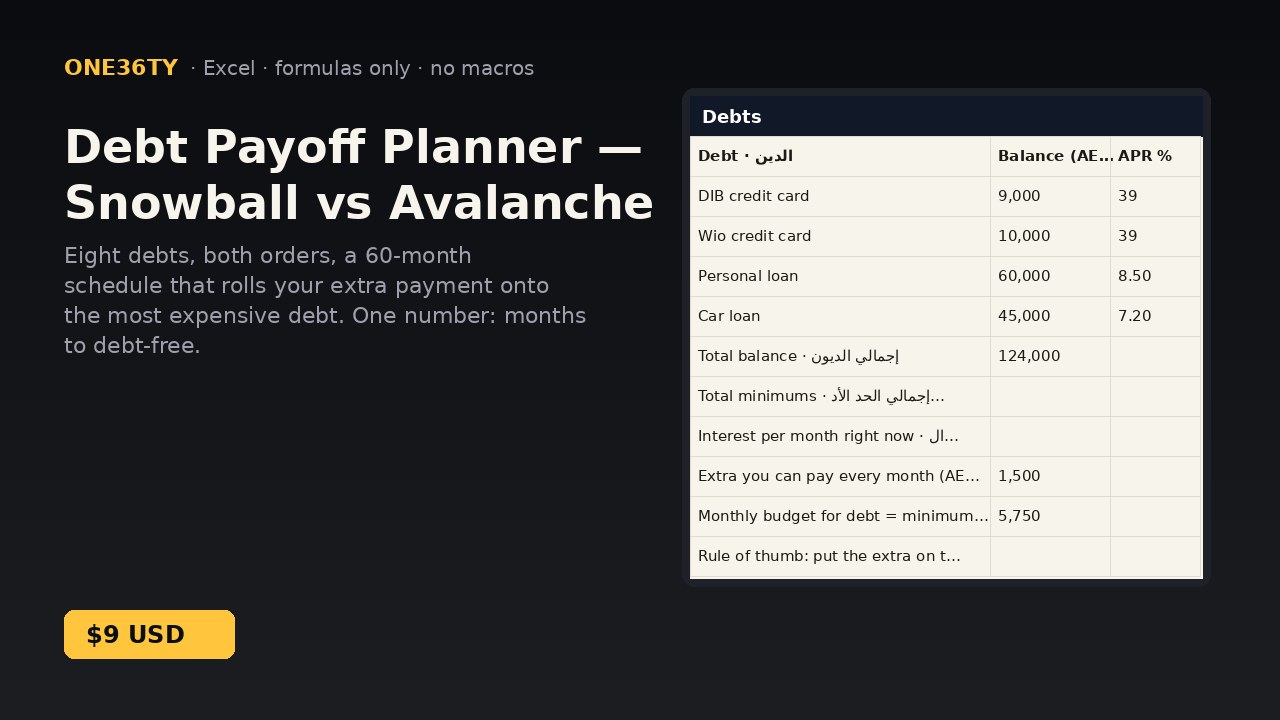
The debt payoff planner in the studio's finance set lists up to eight debts, ranks them both ways and builds the sixty-month schedule for each, so the interest gap and the first-closure month sit side by side for a real set rather than a made-up one. It was built around a 39% card rate, which makes the avalanche's case louder than my 36% did.
The arithmetic is not in dispute. Rate-first always costs the same or less. The only open question is which schedule a particular person will still be following in month twelve, and that is not something a spreadsheet can rank.
Sources
- How to reduce your debt · Consumer Financial Protection Bureau (16 Jul 2019)
- To Beat Debt, Consider Starting Small · Kellogg Insight, Northwestern University (8 Jan 2014), on Gal and McShane, Journal of Marketing Research 49 (2012), 487-501