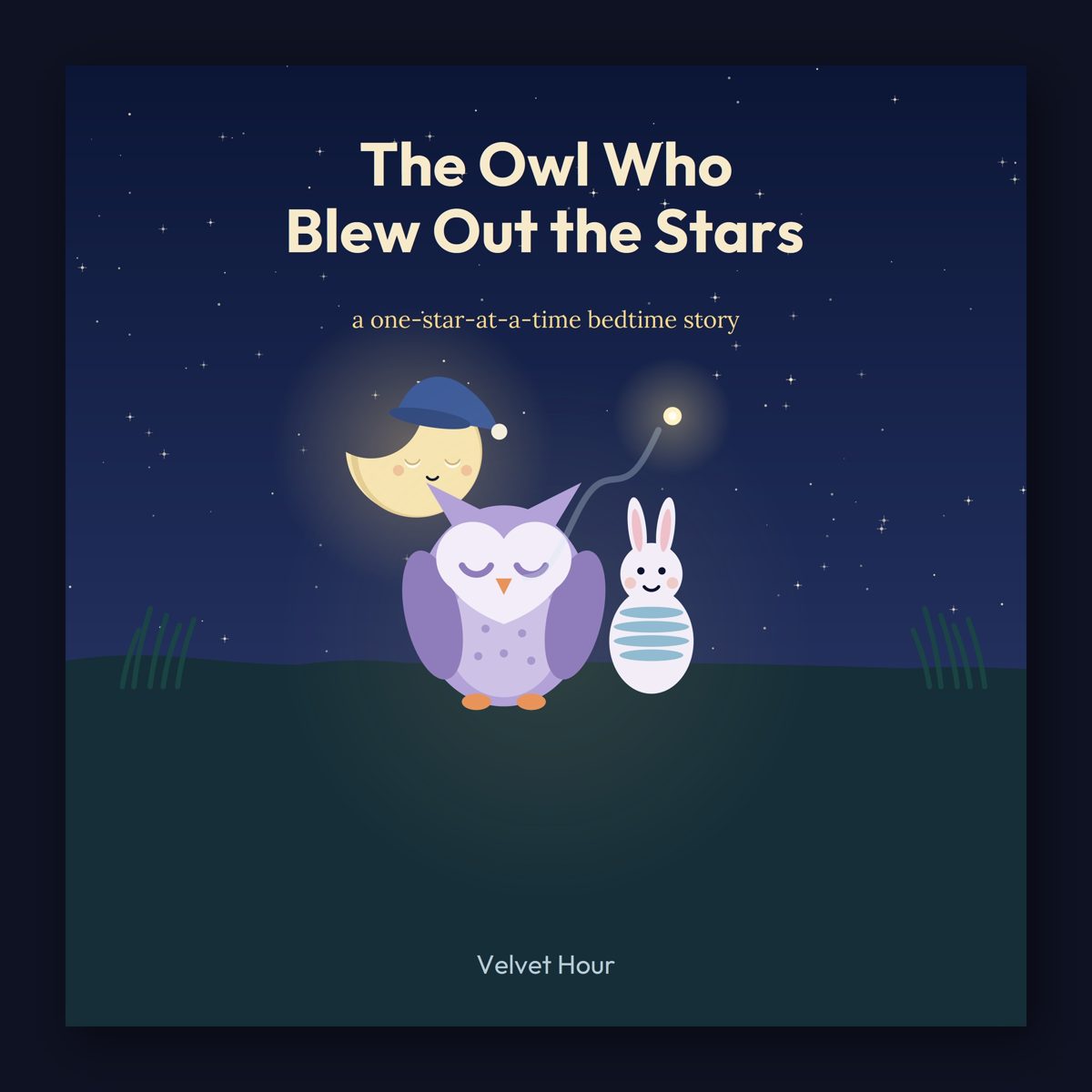
The Owl Who Blew Out the Stars: dimming the room in steps for a toddler who stalls at lights out
When lights out is one switch, it becomes the moment a two-to-five-year-old bargains. A four-step dimming sequence for the last half hour, what to say when the child asks for one light back on, and how The Owl Who Blew Out the Stars models it one star at a time.
Watch this as a video
The Owl Who Blew Out the Stars | A Calming Bedtime Story for Ages 2-5 | Velvet Kids Hour · Velvet Kids Hour · opens on YouTube
It is twenty past seven. Pyjamas are on, teeth are done, the book is closed, and a hand is on the switch. "Wait. I need water." Then a question about tomorrow. Then a smaller toy that suddenly has to be found. None of it started until the hand reached the switch.
I have watched this enough times to think the switch itself is the problem. One click turns a bright room dark, and a two-to-five-year-old can see it coming. The second before the click is the last moment anything can still happen, so that is where the bargaining goes.
Why does a toddler stall right at lights out?
Because it is the only sharp edge in the evening. Bath, pyjamas and teeth flow into each other, but the switch is a clear before and after. A child who would lie down happily in a dim room will often push back against a sudden dark one, not always out of fear, but because the click is the moment the day is announced as over.
That part is my experience, not a study. What the guidance does say is that the half hour before sleep should already be slowing down. The NHS advice for young children is to "start a 'winding down' bedtime routine around 30 minutes before the time that your child usually falls asleep." The Cambridgeshire and Peterborough NHS children's service is more specific about the room: "Dim the lights and switch off devices such as the TV, games consoles, computers, and tablets 1 hour before bedtime."
Read together, those lines put the light falling across the evening rather than at the end of it. Then there is no single moment left to stall at.
How do you dim a room in steps?
Four steps, spread over roughly the last 30 to 40 minutes. The exact times matter less than the order, and the order matters less than doing it the same way every night.
| Step | When | What changes | What it signals |
|---|---|---|---|
| 1. Big lights off in the shared rooms | 30 to 40 minutes before sleep | Living room drops to one lamp; screens go off | The busy part of the evening is over |
| 2. Bedroom on a lamp only | Bath and pyjamas | The bedroom ceiling light never comes on | This room is already the quiet one |
| 3. Lamp off, reading light on | The story | One small light, angled at the page | Only the book is lit |
| 4. Reading light off, nightlight stays | After the last page | Nothing else changes | The book ended, and so did the light |
A few things make the sequence hold:
- The child can help with steps one to three, switching off the living room lamp or choosing which lamp stays on. The last switch belongs to the adult and happens quietly, without an announcement.
- The bedroom ceiling light stays off from bath time on. If it comes on for pyjamas, the room has to go dark again later, which is the cliff the sequence removes.
- If the child already sleeps with a nightlight, it goes on at step two and stays. The NHS line on this is short: "Leave a dim light on if necessary." Whatever is on at step four should still be on at two in the morning.
- Screens belong to step one, not step four. The same Cambridgeshire page says "The blue light from the screens will keep your child's brain awake for longer," and a tablet in bed undoes the whole staircase.
A room that gets darker in four small steps leaves no single switch to argue with.
Where does the story fit in the sequence?
At step three, and this is why I like a book that does the same thing on the page. In The Owl Who Blew Out the Stars, high on Quiet Hill, when the sky turns deep and blue, Pip the owl blows the stars out one at a time: puff, dim, hush. Nib the rabbit breathes along beside her, and down in the village the windows go dark one by one. Each page repeats the same rhythm and slows it a little more, until the last star fades and the Moon closes his eyes.
Read under a single small light, the book does what the room has been doing. The child has just watched three lights go out around the house and now watches the stars go out the same way. By the last page the dark is not news; it is the next step in something they have followed for half an hour.
Two reading habits help. Read each "puff" as an actual slow breath out, so the child can copy it, the way Nib does. Then leave the reading light on for a few seconds after the last page and switch it off without a word, as if it were one more star.
What do I say when the child asks for one light back on?
Some nights they will. "Just the lamp." It helps to decide the answer in advance, because the one I give at twenty to eight is rarely the one I would choose at six.
What I use is the same short line every time: "The lamp is asleep now, like the stars. The nightlight is still on." Then nothing more. No discussion about which lamp, no five more minutes of the big light. If the child gets out of bed to switch something on, the NHS advice covers it: "If your child gets up, keep taking them back to bed again with as little fuss as possible." Calm, boring, the same words.
If the request comes from fear rather than stalling, a dim nightlight answers it better than reopening the sequence. What does not work, in my experience, is handing back one light as a reward for lying still. That turns the last step into something to bargain for, and the edge comes straight back.
This is a routine, not medical advice. Sleep trouble that goes on for weeks is a conversation for a health visitor or GP.
The switch was never really the problem. It was the only visible ending in the evening, so it collected every bit of resistance the evening had left. Spread that ending across four lights and a story, and the last click becomes the smallest one.
Sources
- Sleep and young children · NHS
- Sleep routines for toddlers and children · Cambridgeshire and Peterborough NHS Children's Health