How to read a bedtime story for kids at the pace of their breathing (Whale Song Lullaby)
How to read a bedtime story for kids so it settles them: start at the child's own breathing, read one breath per page, let each out-breath grow a little longer, and stop after one story. A page-by-page method with Whale Song Lullaby, and the nights to skip it.
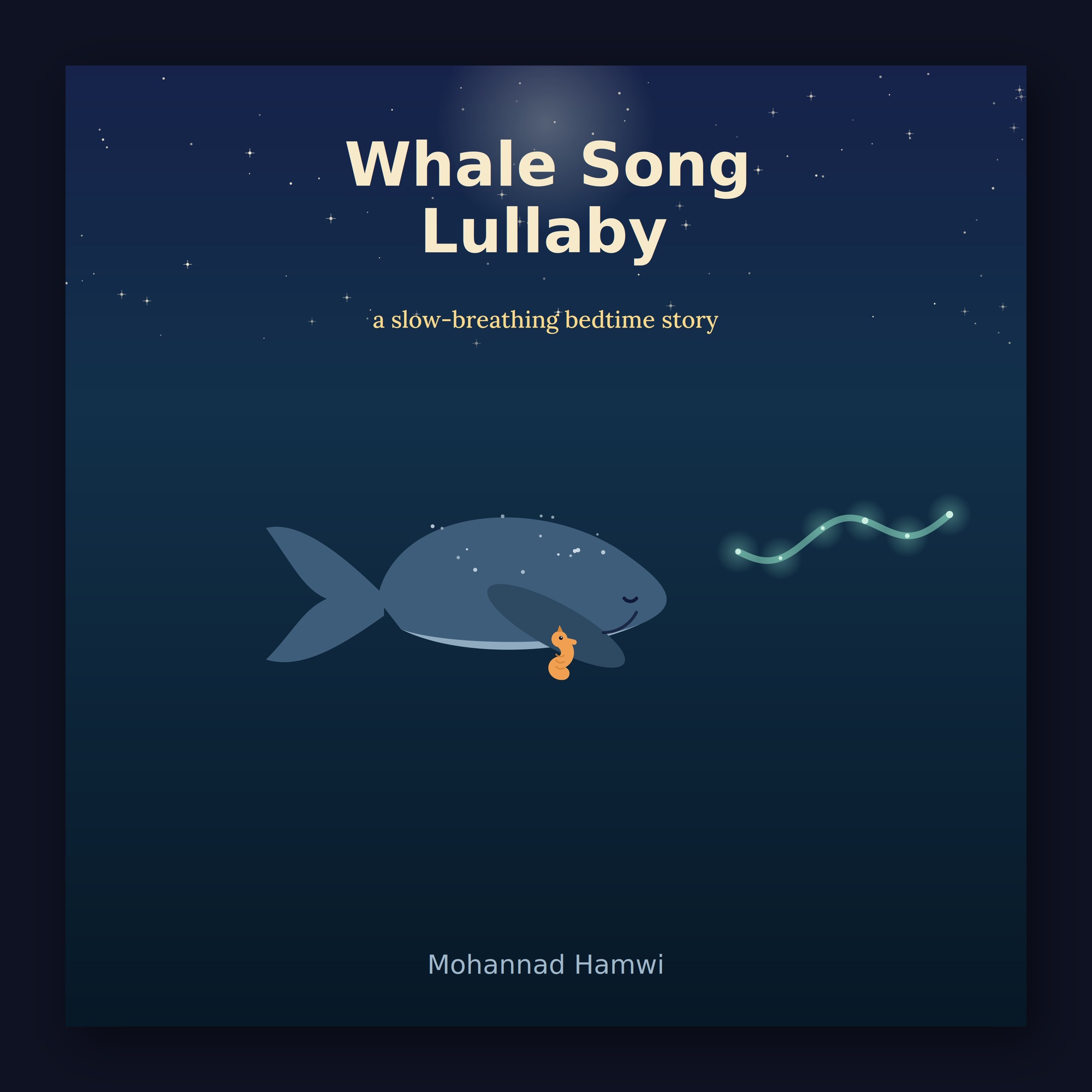
Twenty-six pages, one slow breath in and one slow breath out on each. That is the simplest answer I have to how to read a bedtime story for kids: start at the child's breathing rather than the book's, read each page on one breath, and let every out-breath run a little longer than the last until the story ends. In Whale Song Lullaby night falls on the ocean, the water listens, and Wren the whale begins her long, slow song. Then one by one the fish, the jellyfish, the turtle and the crabs drift off to sleep, all rocked by the same rhythm. I made it so the pacing would live in the pages rather than in the reader's talent, but there is still a right way and a wrong way to read it, and the difference is mostly about where the reader starts.
This is the practical version: what I do before the first page, on each page, and on the nights I leave the book on the shelf.
How do I find a child's breathing before the story starts?
Not by asking. "Take a deep breath" turns breathing into a task, and a three-year-old given a task will do it loudly, twice, and then laugh. I watch instead.
- Get the child lying down with the quilt over their chest before the book opens. Breathing is easier to see as the quilt rising and falling than anywhere else.
- Hold the book closed and follow their breaths silently for a few cycles. I do not time it. I only want the rhythm in my own body before I start speaking.
- Breathe with them for two or three cycles, just loud enough to be heard. That is the starting tempo. It is almost always faster than the one the book is written for, and that is fine.
The mistake I made early on was starting at the book's tempo. A child breathing fast does not drop into a slow rhythm because an adult has begun reading slowly. They notice the gap, and the gap makes them fidget. Starting where they are, and leaving there gradually, works better.
Start at the child's breath, not the book's. The book is where the two of you end up.
What does one breath per page actually sound like?
Each page is paced to one breath in and one breath out. I read the opening of the line on the in-breath, softly, and the rest on the out-breath, letting the voice fall away at the end. Then I turn the page in the pause before the next breath, never in the middle of the words.
For the first few pages I keep the child's tempo. The water listening, Wren beginning her song: these go at whatever speed their breath is going. From the fish onwards, each out-breath gets a little longer than the last. Not much. I let the last word of the page trail for one more beat than felt natural on the page before.
The roll call does the rest. The fish drift off. The jellyfish drift off. The turtle, then the crabs. Each new sleeper is a natural place to lengthen the pause, because the picture has changed and the child is looking rather than listening. By the crabs, if it is working, the quilt is rising and falling at something closer to the reader's pace than the child's own.
Three things I avoid on every page:
- Asking questions about the pictures. "Where's the turtle?" restarts the conversation, and the fast breathing with it.
- Doing voices. Wren's song is described, not performed. A sung whale is exciting.
- Speeding up for the page turn. The turn is part of the out-breath, not a gap to fill.
It is the same per-page slowing I use for a pass-it-on yawning story, where the yawn does the work the breath does here.
Why this seems to work I can only report from my own reading; I have no study that measures a child's breathing against a reader's. What I can say is that a book like this is easier to read badly than a story with a plot, because there is nothing to explain and nowhere to rush to.
When is a breathing story the wrong pick?
The method assumes a child who is already slowing down and needs help with the last stretch. Some nights that is not the child in the bed.
- The overtired, wound-up child. Rolling, kicking, laughing at nothing. There is no steady breath to find, so there is nothing to match. On those nights I get the quiet in first: lights low, a slow wash, a tuck-in that gives their body something to do. The breathing story comes after, or not at all.
- The child who is upset. Crying breath is not a rhythm to lead. Comfort comes first, and a story paced to breathing can feel to an upset child like being asked to calm down on a schedule.
- The blocked nose. A child breathing through the mouth at the end of a cold will not settle into a slow in-and-out pattern, and I would not try to make them. A familiar, plain story suits that week better.
- Too late in the evening. The NHS suggests a wind-down that begins well before sleep: "Start a 'winding down' bedtime routine around 30 minutes before the time that your child usually falls asleep." A breathing book read at the very end of an evening that skipped that wind-down is being asked to do thirty minutes of work in six. Getting the clock right matters as much as the reading; I worked through what bedtime for a 2 year old actually is in a separate post.
The same NHS page has the line that keeps this book in its place: "Set a limit on how much time you spend with your child when you put them to bed. For example, read only 1 story, then tuck your child in and say goodnight." Whale Song Lullaby is meant to be that one story, not a tool to repeat until it works. If the crabs have drifted off and the child has not, the book closes anyway, the light goes off, and the rhythm the two of you found on the way stays in the room.
What making it taught me is that a slow book does not slow a child down on its own. The reader does, by starting where the child is and taking them somewhere quieter, one page at a time.
Sources
- Sleep and young children · NHS